Author: Kiupit Editorial

  • Infatuation vs love: the stages every relationship goes through

    Infatuation vs love: the stages every relationship goes through

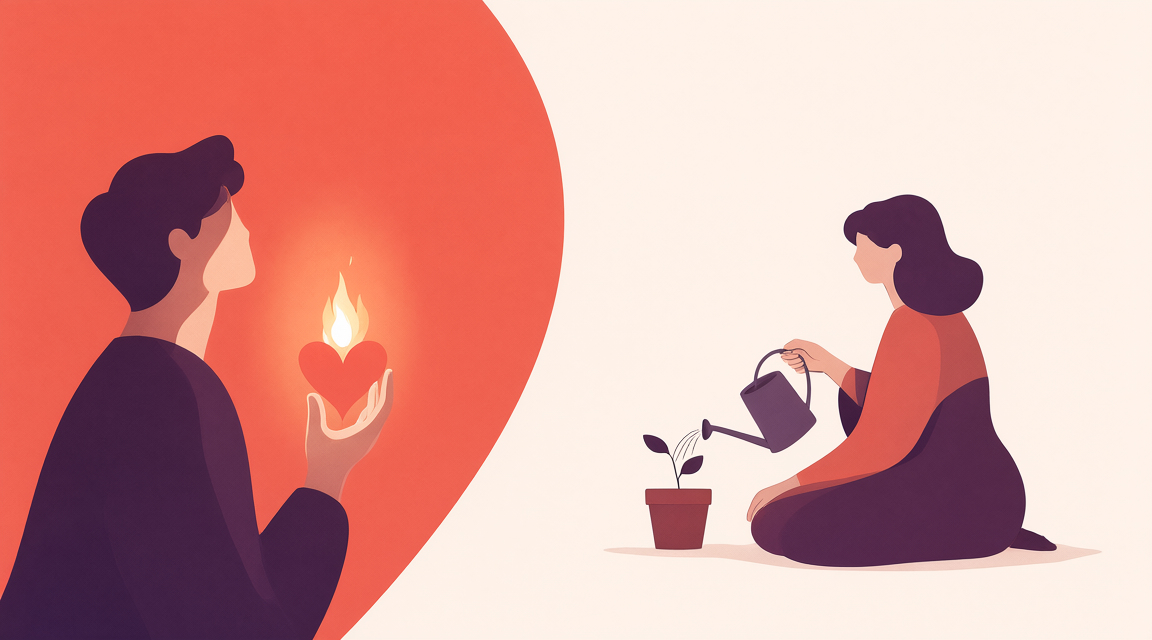
    Most avoidable breakups don’t happen because of betrayal or incompatibility: they happen because two people mistook the end of infatuation for the end of love. The butterflies leave — it’s their job to leave — and someone thinks “I don’t feel it anymore, this isn’t love.” They look the other way, or cut the relationship, exactly at the moment when love, the real kind, was starting to become possible.

    This guide explains what each thing is, why infatuation has an expiration date by design, and how to tell whether you’re in the crisis that breaks couples or the one that builds them. No fluff, with names attached: this is fairly standard relationship psychology (Sternberg, Fisher, Gottman’s stage work) told in plain language.

    What infatuation is (and why it leaves)

    Infatuation is a neurochemical state, not a soft emotion: dopamine (obsession, energy, euphoria), norepinephrine (racing heart, no sleep), and a serotonin drop (the same obsessive pattern as OCD). You are literally “crazy” about that person, and it’s functional craziness: it’s designed to pull you together and bond you.

    Three facts that define it:

    • It’s projection: you don’t fall for the real person, but for a version edited by your brain under the best lighting. The filters exist so the initial investment feels worth it.
    • It has a deadline: 6 to 24 months typically. Not a flaw: the dopaminergic system can’t sustain euphoria indefinitely. Nobody has been infatuated (like that, capital letters) ten years running.
    • It’s deliberately blind: idealization ignores signals that would alarm you in any other context. That’s why red flags get seen late.

    When the cocktail wears off, you haven’t “run out of love”: you’ve finished phase one. The real person shows up. And there are two possibilities: you like the real person, or you don’t. That’s the question of this phase.

    The stages that come after

    Phase 2: power and negotiation (months 8-24)

    Idealization drops, differences rise: money, tidiness, family, sex, time. The “I” appears against the “we.” This is where most young couples break up, because every conflict gets read as “they’re not the one.” Wrong: it’s the first time you see each other without filters. Conflict here isn’t a bad sign; not being able to talk about it is.

    Phase 3: decision (2-4 years)

    Chemistry no longer forces you: staying becomes a daily choice. This is the conscious commitment phase: I know this real person, flaws now visible, and I choose to build with them. Here love stops being something that happens to you and becomes something you do.

    Phase 4: mature love (years)

    Secure attachment, oxytocin and vasopressin instead of dopamine: calm, safety, complicity. Less euphoria, far more support. Couples who describe it as “boring” are usually comparing it to phase one — like comparing a bonfire to your home’s heating: one dazzles, the other keeps you alive.

    Why people break up exactly when “I don’t feel it anymore”

    The interpretation error: using the intensity of infatuation as the thermometer of love. If your only evidence of love is euphoria, the moment it drops (and it always drops, for everyone, in every relationship) your brain concludes “they weren’t my person” and the dating market whispers that someone else will make you feel “that” again. They will — and it will also end again. It’s a relationship-breaking machine.

    Signs you’re in the phase 2 crisis and not in the wrong relationship:

    • With this specific person, problems can be discussed.
    • Your life with them is good overall, even without euphoria.
    • You like them. Really: do you like their character, not just their chemistry?
    • When you picture five years with them, your body says “yes,” even if your head misses the butterflies.

    If instead there’s contempt, control or aggression: this isn’t the end of infatuation, it’s a damaging relationship. The exit there is different (it’s in the toxic relationship signs guide).

    How to talk about this with your partner

    The conversation that saves phase 2: “Lately I don’t feel like I did at the start. I want to talk about what this is for us.” Three rules: no accusations (“you don’t look at me anymore”), no catastrophizing, and one joint question: what are we building? If both of you understand that the drop in intensity is the normal calendar and not the final judgment, you cross the crisis. If only one understands, the relationship stands on one knee.

    And a practical note: couples who survive phase 2 aren’t the ones sustaining euphoria — impossible — but the ones who renew novelty inside the bond: projects together, separate spaces, small surprises, talked-about sexuality. Novelty doesn’t kill love; un-talked-about routine does.

    Frequently asked questions

    Is real love “boring”?

    It’s calm, which isn’t the same. If calm feels unbearable, it’s worth examining why: people who only recognize love as intensity often have a history of rollercoaster relationships (and sometimes, of home life).

    Exactly how long does infatuation last?

    Between 6 and 24 months on average, according to the research (Fisher and others). With intermittent contact (long-distance, undefined relationships) it artificially stretches: uncertainty keeps dopamine high. That’s why a two-year “situationship” feels like intense love and is nothing but phase one on a loop.

    Can you feel butterflies again with the same person?

    In bursts, yes: an external threat, a reunion after a trip, a new project together. But the healthy goal isn’t recovering phase one: it’s taking care of phase three. Butterflies are the trailer; love is the show.

    Keep reading

    If jealousy is involved in your relationship, this pairs with it: how to deal with jealousy in a relationship. And if distance is what’s cooling the bond: long-distance relationships, how they work.

  • Unique gifts for your partner: the guide by personality and budget

    Unique gifts for your partner: the guide by personality and budget

    The best partner gift isn’t the most expensive one: it’s the one that proves you were listening. You can tell in a second when someone gifted “a gift-shop item” versus when someone gifted the thing you mentioned in passing three months ago. Good news: that can be planned without being a genius. You need two things — paying attention, and this guide.

    Context to size the bar: on Valentine’s Day alone, US consumers spent a record 29.1 billion dollars in 2026 (NRF), averaging close to 200$ per person. So the “expected gift” bar is high — but most people buy the same way (flowers, dinner, perfume). One well-thought-out gift puts you ahead of that average on a fraction of the budget.

    The golden rule: gift = listening

    Before browsing a single store, review:

    • What they asked for months ago and won’t buy themselves (“that book”, “that good pan”, “those headphones”). The most underrated gift is the treat people won’t give themselves.
    • What they do in their free time: that’s where the personality guide comes in.
    • What they’re embarrassed to admit they like: the “I truly see you” gift counts double.

    One filter question for everything: would they use/enjoy this even if I weren’t around? If the answer is “only if we do it together”, it’s a plan, not a gift — and plans count too (they’re in the anniversary guide).

    Guide by personality

    The foodie

    Not “another dinner”: an edible experience. Tastings (wine, specialty coffee, beer), a short class (sushi, fresh pasta, sourdough), a box of products they can’t find locally (DOP cheeses, hot sauces, single-origin chocolate). Flexible budget: a 30-50$ box works as well as a 150$ tasting menu.

    The traveler

    Don’t gift the trip if you can’t pay for it together: gift the next getaway organized by you (route locked in, booking made, destination a surprise until arrival). If they travel solo: gear that removes a real problem (quality packing cubes, a neck pillow that actually works, a premium universal adapter).

    The reader / podcast person

    Special edition of their favorite book, an Audible/Storytel subscription, a decent reading lamp, or a “for the coming year” box: 3 books chosen by you, each with a dedication. This personality values that someone read their tastes.

    The gamer / tech person

    Dangerous territory: don’t gift tech unless you know exactly what they want (parts and peripherals are a compatibility minefield). Safe: a gift card for their platform with a little extra on top, a quality stand or controller dock, ambient lighting for the setup, or merch from their favorite game (that one almost always lands).

    The practical one

    Hates “useless” gifts? Gift premium utility: the good version of something they use daily (chef’s knife, gym towel, thermos bottle, multi-port GaN charger). The formula: object they already own → the quality version they’d never pay for. It’s the gift most appreciated at minute five and most used at year one.

    The nostalgic

    Handmade territory: a photo book of the past year (photo-book services: 20-40$, done in an afternoon), a “5 reasons / 5 memories / 5 dates for when you miss me” box, your first-date dinner recreated at home. Ridiculous budget, enormous impact.

    By budget

    • Under 30$: a well-made personalized item (a good framed photo, a box of their favorite snacks from the big store), a home-cooked experience. Key: presentation. A 15$ gift wrapped with care looks like 50$.
    • 50-100$: the king range. Tastings, short classes, premium box + dinner, the good version of their daily object, tickets to something they want to see.
    • 100-250$: day experiences (spa, tasting dinner, countryside escape), safe entry tech (upper-mid headphones if you know their taste), discreet jewelry.
    • 250$+: at this point don’t buy: plan. A weekend away, the experience they’ve mentioned for years. And for a big date (wedding, round anniversary), better to discuss a shared budget than shoot in the dark.

    The mistakes that send the gift to the drawer

    1. Gifting yourself: the video game you want to play, the team you follow. Shows from a mile away.
    2. The gadget they didn’t ask for: “just in case they like it” tech. If they haven’t mentioned it, no.
    3. Clothes without certainties: size and style are a lottery; if you risk it, include the receipt for exchanges.
    4. The gift-as-reproach: running shoes “so you run”, a book “so you read”. A gift isn’t a personal trainer.
    5. Buying on February 13th: availability and idea quality crater during hot dates (Valentine’s, anniversaries, Christmas). Plan 2-3 weeks ahead: that’s the difference between “I thought about it” and “I bought it in a rush”.

    Frequently asked questions

    Object or experience?

    The happiness research is fairly consistent: experiences win… with a catch: the experience must fit the person (a concert for someone who hates noise loses). For purely material personalities, a well-chosen premium object works better. Winning combo: experience + small object that remembers it (the race shirt, the tasting’s wine cork).

    How much should I spend?

    What you can without forcing it. A gift that leaves you in the red next month puts strain on the relationship. Average US Valentine’s spending is around 200$, but satisfaction doesn’t scale with price: it scales with “they listened to me.”

    Is gifting money okay?

    As a base, yes; as the only gift, no. The formula: the experience or the detail + a contribution to what they truly want. “This is for the diving course” with 50$ inside is infinitely better than 150$ in an envelope.

    Keep reading

    For the big dates, the guide to anniversary ideas by budget. And if your partner lives in another city, this matters too: best couples apps in 2026.

  • Anniversary ideas by budget: plans that actually work (from free to a weekend away)

    Anniversary ideas by budget: plans that actually work (from free to a weekend away)

    An anniversary doesn’t need more money: it needs more attention. That’s the law that repeats every year: 150$ spent on a hurriedly booked dinner gets remembered less than that free afternoon when you did something new together. It’s not that money doesn’t matter: it’s that an anniversary celebrates a shared story, and stories get celebrated with presence and novelty, not with receipts.

    That said: budgets are real, and knowing what to do with 0$, 50$ or 300$ is the difference between a solved plan and a night of “should we just order in and watch something?”. This guide goes by range, with the formula underneath so you can invent your own plans.

    The formula behind a plan that works

    A memorable anniversary has three ingredients. With two of three, it works:

    1. Novelty: something you don’t always do (new route, never-tried restaurant, never-done activity). The brain codes new things as “more time together.”
    2. Full attention: no scrolling, no work, no “I’ll check email after.” A 20$ plan with phones in a drawer beats a 200$ plan with notifications.
    3. Shared history: something that speaks about you two (returning to the first-date spot, recreating the first dinner, resuming the game you played at the start, cooking the dish from your first trip).

    The perfect plan is the intersection of all three. The plan that fails almost always fails on number two: the experience gets paid for but lived distracted.

    Plans by budget

    0-20$: the at-home night, leveled up

    • Restaurant night at home: pick a real restaurant, order (or cook) its signature dish, play the venue’s music, dress as if going out. The ritual is the plan.
    • “Our museum” night: each of you prepares 5 photos/memories from one year of the relationship and presents them like a museum tour. Ridiculous and devastating.
    • Picnic route: the market’s best food stall + the spot with the best view in town. Budget: the bag.
    • Themed marathon: the movies that introduced you, with the popcorn from back then.

    20-60$: dinner + something

    • Dinner at a new place (not the expensive one: the never-tried one) + a walk through an area you don’t know.
    • Upgraded at-home tasting: two wines from a specialty shop (let them advise you), cheeses, blind tasting at home with scores. 40$ and two hours of real conversation.
    • Daytime activity + short dinner: escape room, bowling, sunset hike, one-afternoon pottery class. The activity breaks the routine; dinner closes it.

    60-150$: the full day

    • Day-trip escape: nearby town with a route + lunch at a countryside inn + drive back at sunset. The “without the overnight” format halves the price and doubles the adventure feeling.
    • Guided experience: winery tour and tasting, tasting dinner for two, couples massage, tickets to that band you both like (timing rules here: buying tickets weeks ahead is half the plan).
    • The themed day: “Italian day” (Italian market + Italian cooking + Italian movie + Italian dessert), “tourists in your own city day” (the spots you never visit).

    150$+ and the weekend: the disconnect

    • Charming escape: countryside house with fireplace/hammock/tub (the house’s detail IS the plan), in low season: same quality, half the price. Book direct: usually beats the platform.
    • The experience they’ve mentioned for years: the big concert, the hotel with the view, the weekend course on their passion. If you know it by ear and keep it in your notes, you win by default.
    • The weekend rule: one big block + free space. Overloaded anniversary plans (hour by hour) end in exhaustion, not memory. Leave Sunday empty.

    Difficult anniversaries (the ones nobody covers)

    • First anniversary after a crisis: don’t fake normalcy with a postcard plan. Low-key plan, no pressure, with an honest conversation inside: “this year was hard and I want to celebrate that we’re still here.” Honesty IS the detail.
    • Anniversary with small kids: the plan isn’t the spa, it’s the solved plan B (grandparents/sitter confirmed BEFORE announcing anything). An anniversary canceled twice is worse than a modest one delivered.
    • Long-distance anniversary: simultaneous dinner over video call with the same order, or the visit as the gift: “next month I’ll be there, it’s all booked.” Concreteness beats flowers.
    • Anniversary in a year of grief or loss: turn the volume down and the presence up. A walk and a quiet dinner, without forcing the party.

    Frequently asked questions

    Does the anniversary get celebrated on the exact day?

    The exact day gets the small detail (the letter, the breakfast) and the big plan goes to the nearest weekend. Logistics shouldn’t break the date: separate the layers.

    Do you have to gift something on top of the plan?

    Not mandatory. If there’s a gift, make it small and tied to the plan (the printed photo of the day, the wine cork from dinner). Plan + symbolic object is the combo that gets remembered most.

    How often should you go all out?

    One big blowout for the round years (5, 10, 25) and the rest, formula + presence. Comparing internally with the fancy-hotel year is a trap: the memory bar is set by attention, not price.

    Keep reading

    If you prefer objects over plans (or as a complement), the guide to unique gifts for your partner. And if what you need is understanding where the relationship stands: infatuation vs love.

  • Best couples apps in 2026: shared calendars, chores and finances

    Best couples apps in 2026: shared calendars, chores and finances

    Most couples don’t fight about love. They fight about logistics: who picks up the dry cleaning, what’s on the grocery list, why nobody paid the electric bill, whose turn it is to plan Friday. A well-chosen app won’t fix a relationship — but it deletes about a third of the stupid little arguments that slowly erode it. This is the honest guide: what app does what, no smoke.

    Rule before installing anything: the best app is the one you both actually open. A couple with a shared Google Calendar and one clear rule beats a couple with five couples apps that one person maintains alone. Install the minimum, use it for three weeks, expand only if it sticks.

    Shared calendars: the foundation

    • Google Calendar — The default option and, for 90% of couples, the only one you need. Create a “Us” calendar, share it, each person adds events in their own color. Works on Android, iPhone and web, syncs itself, free. Pro tip: put birthdays, doctor appointments and friend plans in there too; most of the “why didn’t you tell me” fights die in this calendar.
    • Apple Calendar — The equivalent if you’re both on iPhone. Integrates with Reminders and Siri (“what do we have on Saturday?”). Less flexible for sharing with anyone outside the ecosystem.
    • TimeTree — The calendar built for small groups: events, per-event chats and a built-in grocery list. If your problem is “planning without fighting over text”, it’s the friendliest in the class. Free with paid premium features.
    • Cozi — Designed for families: master calendar with individual calendars, chore lists, grocery lists and a meal planner. With kids in the picture it beats everything above; as a couples-only app it’s oversized.

    Chores and grocery lists

    • Todoist (or Microsoft To Do) — Shared lists with assignees and due dates. The killer feature for cohabiting: every task has an owner, so “I thought you were doing it” stops being an excuse. Free tier covers the basics.
    • TimeTree and Cozi — Already have decent grocery lists; if that’s all you need, don’t install anything else.
    • Notion — For geek couples: a shared dashboard for moves, budgets, trips, apartment research. Extremely powerful if you both like organizing; useless if only one of you maintains it.

    Couple finances

    • Splitwise — The reference for splitting costs: log who paid what and the app computes balances. Ideal if you keep separate accounts or live with housemates. Free version is enough; premium adds charts and receipt scanning.
    • Honeydue — Built specifically for couples: connect accounts (US; elsewhere it works as manual entry), assign who pays each bill, see joint spending with alerts. Free. The best pick if you want a “couple treasury” without building a spreadsheet.
    • The classic spreadsheet — If your money conflict is deeper (one spends, the other controls), no app fixes that: that’s a conversation. Apps only remove friction from an agreement that already exists.

    Connection and “couple stuff”

    • Locket — The widget that sends photos straight to your partner’s home screen. Sounds silly, works: micro-contact daily with zero pressure to respond. Especially good for newer relationships or long-distance.
    • Between — A private “social network” for two: chat, shared photo album, calendar and a days-together counter. Huge in Asia, growing community in the West. If you want a space that’s yours outside of texting apps, it’s the most complete.
    • Paired — Psychologist-designed exercises and quizzes to improve communication. Couples therapists use it as “homework” between sessions. Subscription model: try the free trial before paying.

    What to install, by case

    • Moving in together without drama → Shared Google Calendar + Todoist with assignees + Honeydue or Splitwise for money. Three apps, all free.
    • Both on iPhone, no time → Apple Calendar + shared Reminders. Zero friction.
    • Kids or a shared flat → Cozi or TimeTree.
    • Long distance → TimeTree (visit planning) + Locket (daily presence) + Between if you want a private nest. And the guide on making long-distance work.
    • One organizes, the other doesn’t → The app isn’t the problem; that conflict is called communication and gets fixed by talking, not downloading.

    FAQ

    Are paid couples apps worth it?

    Almost never. The free ones (Google Calendar, Splitwise, Todoist, Honeydue) cover 90% of cases. Pay for premium only after a month of daily use where the extra genuinely saves you time.

    What if my partner won’t use apps?

    Don’t build a system that requires 100% of both people. Keep the shared calendar (lowest resistance) and put the rest in one note the other can glance at. The goal is less friction, not another task.

    Do these apps read our couple data?

    The big ones (Google, Apple, Microsoft) have standard privacy policies. If it worries you, skip bank connections and use manual entry in Honeydue/Splitwise. No grocery-list app needs your real financial credentials.

    Does this replace couples therapy?

    No, and anyone selling you that is lying. Apps organize logistics; trust, jealousy and communication problems need honest conversation and, when warranted, a professional.

    Keep reading

    If the shared calendar leads to your first real money argument, see handling jealousy around money and exes. And if you’re living in different cities, start with long-distance relationships: how to make it work (and when not to).

  • Best dating apps in 2026: the honest comparison

    Best dating apps in 2026: the honest comparison

    Every year someone declares that “dating apps are dead” and every year millions of people keep meeting on them. What has changed is the map: each app has its audience, its culture and its level of intention, and picking the wrong one burns months of swiping in the wrong place. This guide goes straight to the only thing that matters: what are you actually looking for.

    Context to size the market: global dating apps are doing around $11.87 billion in 2026, projected to roughly double in the next decade (Verified Market Reports). Meeting online isn’t a phase — it’s now the majority way couples form. The question isn’t “apps or not” anymore; it’s “which ones, and how”.

    The golden rule: two apps, done well

    The winning strategy in 2026 isn’t installing ten apps. It’s choosing two that match your goal, building a real profile (6 clear photos, a bio with one concrete hook, nothing that says “just ask me”), and replying within 24 hours. One mediocre app with a great profile beats five great apps with 2019 dog-filter photos.

    If you want something serious (25-40)

    • Hinge — The favorite of people looking for a partner in big cities. Profiles built on prompts (written answers that start conversations), likes with comments, and a culture of real intention: the app literally markets itself as “designed to be deleted”. If you installed only one app for something serious, this is it.
    • Bumble — Classic swipe with one rule: in straight matches, women message first and matches expire in 24 hours. A somewhat more curated vibe than Tinder and an automatic filter for low-intention profiles. Its weak spot: the expiry kills conversations if you travel or work shifts.
    • Match — The veteran of the “serious relationship” crowd, skewing 30-50. Almost paywalled — and precisely for that it works: people who pay are there on purpose. Its events and dating coaches are a real differentiator.
    • OkCupid — The one with a thousand questions. Its compatibility algorithm is still the most elaborate in the industry; fewer users than the giants above, but much fuller profiles and conversations that start with actual substance.

    If you want volume and to see what happens

    • Tinder — The giant: more users than anyone, at every age and every intention (with a casual bias). If you live outside a major metro or you’re only installing one app “to see”, it’s this one. Its downside: noise, empty profiles and swipe fatigue.
    • Facebook Dating — Completely free and plugged into an audience that left the other apps: 40-60. An underrated gold mine if that’s your bracket.
    • Hinge’s casual corner / Feeld — If exploration rather than volume is the goal, see the next section.

    If you’re 40+ or want declared intention

    • eHarmony — The most “marriage or nothing” of the mainstream apps: long compatibility questionnaire, older-skewing paying members, and a culture where everyone is there for the same reason. Expensive; treat it like a subscription to a goal, not to an app.
    • Match — Again the safe pick in this bracket, especially outside the coasts.
    • Fruitz — The fruit one: each fruit declares your intention (cherry = relationship, watermelon = casual), which kills misunderstandings. Young crowd, 18-30.

    LGBTQ+ and non-monogamy

    • Grindr — The reference for gay, bi and trans men: proximity grid, direct, its own codes. Go in knowing where you’re going in.
    • Feeld — The home of ethical non-monogamy: open couples, polyamory and exploration, with joint profiles and the most label-respectful community in the industry.
    • HER — The biggest dedicated space for queer women and non-binary people; part dating app, part community feed.

    What no app tells you: the profile is 80%

    • Photos: one clear face shot with no sunglasses, one doing an activity that represents you, one social (where you’re still distinguishable) — and nothing blurry, ex-cropped, or from six years ago.
    • Bio: one concrete detail beats ten adjectives. “I know every coffee shop worth visiting in this city” works; “adventurous and sincere” doesn’t.
    • First message: reference something from their profile. A bare “hey” has the response rate of a junk mail letter.
    • Meet early: two weeks of sterile chat kills attraction. When there’s flow, propose something concrete — place, day, one-hour plan.

    Frequently asked questions

    Do dating apps work in small towns?

    Yes, but the strategy changes: Tinder and Facebook Dating still have real volume outside metros, and paid tiers (Tinder Plus, Match) widen your search radius. In very small towns, interest-based meetups and word of mouth still beat any swipe.

    Should I pay for premium?

    Only once you’ve confirmed a hypothesis: two months of free use with decent conversations, and you want more filters or radius. Paying before you know whether your profile works is buying an expensive excuse not to fix it.

    How much time should I spend?

    Thirty minutes a day, spread out — not four hours on Sunday. The apps reward consistent activity, and your mental health does too: compulsive swiping manufactures the illusion of progress without results.

    What if it’s been months without a single date?

    The problem is almost never the app: it’s the profile or the radius. Have two honest friends review it, swap photos and bio entirely, and try the higher-intention app for your bracket (Hinge or Match). If three rounds of changes don’t move the needle, a one-month break usually does more than one more frustrated month.

    Keep reading

    If you’re coming out of a breakup and dating “to plug the hole”, the guide on how to get over a breakup explains why that gets expensive. And if it works out and you need to organize a shared life: best couples apps in 2026.

  • Long-distance relationships: how to make them work (and when to quit)

    Long-distance relationships: how to make them work (and when to quit)

    “Long-distance relationships don’t work” is the laziest line in the dating manual. The data say otherwise: in a OnePoll survey of 1,000 people, around 58% of those who had been in a long-distance relationship said it ended in success. The important nuance is on the other side of the statistic: the ones that work almost never work by accident. They work because they have structure — and the ones that don’t drag on for months before breaking.

    This guide is honest in both directions: how to do it right, and how to recognize in time that it isn’t going to.

    Why distance can be better than you think

    Research on mediated communication has pointed to a counterintuitive effect for years: long-distance couples tend to talk better. Without the routine of seeing each other daily, conversation becomes more intentional: you share things you’d keep silent about under cohabitation, and the idealization of the next visit injects a spark many “close-by” couples have lost. Distance doesn’t create problems; it amplifies the ones already there. A solid relationship at 500 miles is solid; an empty one at five miles breaks just the same, only later and with more U-Hauls.

    The real cost is something else: logistics. Time, money, emotional energy and airport fatigue. Owning that from day one avoids the crash of months three to six, when the novelty wears off.

    The five rules that separate the ones that work from the ones that drag on

    1. An end date for the distance, even a rough one

    This is the single most powerful predictor of all: couples who plan their eventual reunion have far higher success rates (some market figures put it around 65% versus 33% when there’s no plan). You don’t need a notarized date: you need a direction. “In six months I’ll look at transfer options” or “as soon as the lease ends we figure out the same city.” Without a horizon, the relationship is waiting; with a horizon, it’s a project.

    2. An agreed contact rhythm, not an improvised one

    The classic conflict: one wants a daily video call, the other needs space. There’s no right answer; there’s an explicit agreement. Set a minimum (for example: a good-morning text every day, one long call two or three times a week, a weekly video call) and respect it the way you’d respect a date. Consistency beats intensity: 20 real minutes daily is better than a five-hour marathon every fortnight. Time zones count too — “tonight at 11” is a small tax you both keep paying; notice when it stops being cute.

    3. Visits on the calendar from the start

    Every reunion should be booked before the previous one ends. Not for romance: because the countdown is the oxygen of the in-between. If two months go by with no visit on the books, the relationship enters survival mode — and that’s exactly when “I met someone here” shows up.

    4. A life of your own (and talking about it)

    The most common mistake is making the long-distance relationship the center of the universe and emptying your local life. That kills the conversation (there’s nothing new to tell) and creates dependence on the other person as your only source of mood. The long-distance couple that works is two people with full lives who share them. Friends, gym, work, hobbies: all of that is content for Thursday’s video call.

    5. Operational transparency, not surveillance

    “Who are you out with?” can be trust or control; the difference is frequency and tone. The practical rule: information that flows without interrogation. If you need to check their phone or demand 24/7 location sharing, the problem isn’t the distance: it’s jealousy, and distance just makes it easier to disguise. There’s a full guide on how to deal with jealousy in a relationship for that case.

    Signs you’re maintaining an illusion

    With care, but without beating around the bush. Consider yourself addressed if you recognize three or more:

    • You speak in perpetual conditional: “when we see each other”, “when they move”, “when the contract ends”… and the years pass and the conditionals stay.
    • Neither of you has raised the move: if “living in the same city” is systematically dodged, it’s not that the timing is wrong — it’s that the intention isn’t there.
    • The relationship only exists on screen: no visits in months, no real plans, sustained by morning texts and nightly video calls. That’s virtual company, not a relationship on pause.
    • You know their life by heart and they don’t know yours: asymmetry of interest. Whoever asks less, invests less.
    • Your close friends don’t see you lit up: the people around you usually spot the pattern before you do.
    • You’ve felt more anxiety than joy for months: a relationship, near or far, should add more than it costs. If the balance has been negative for months, you already have your answer.

    The most common ending (and how to do it right)

    Most long-distance relationships don’t die from a fight: they die from logistical exhaustion, or from closing the distance. The relocation paradox is real — “we worked apart and moving in broke us”: living together dismantles the idealization of the reunion. The antidote: arrive with realistic expectations (not a sealed “forever” signed at the airport) and an agreed trial phase, with separate places to retreat to if needed.

    And if it’s time to end it, end it the way it deserves: over a decent video call, with clarity and no “maybe someday”. Someone who kept crossing airports and interstate drives every two months deserves a goodbye at that level.

    Frequently asked questions

    How long can a long-distance relationship last?

    Without a closing plan, most run out of steam between 6 and 18 months. With a rough reunion date and regular visits, many last for years and come out stronger. The limit isn’t time: it’s the absence of a horizon.

    What counts as “long distance”?

    The label doesn’t matter; the real contact rhythm does. 100 miles with a direct train and weekly visits is another category; 100 miles with no transport and one visit a month functions like an international one. Two time zones changes the math even at short driving distance.

    Is it better to start long-distance or meet someone close?

    Starting long-distance is harder: there’s no shared base to hold up the idealization. It works when the connection is clearly exceptional; not when it’s “well, why not”. If you met on apps, be clear on which app fits your situation and whether your city has enough volume before widening the radius to another state or country.

    Are daily video calls healthy?

    What’s healthy is the agreement, not the frequency. Daily works for some couples and smothers others. The alarm signal isn’t the number of calls: it’s when not calling feels like relief.

    Keep reading

    If you’re coming out of a breakup and fear of distance is what’s holding you back: how to get over a breakup. And if it gets serious and two separate lives need shared logistics: best couples apps in 2026.