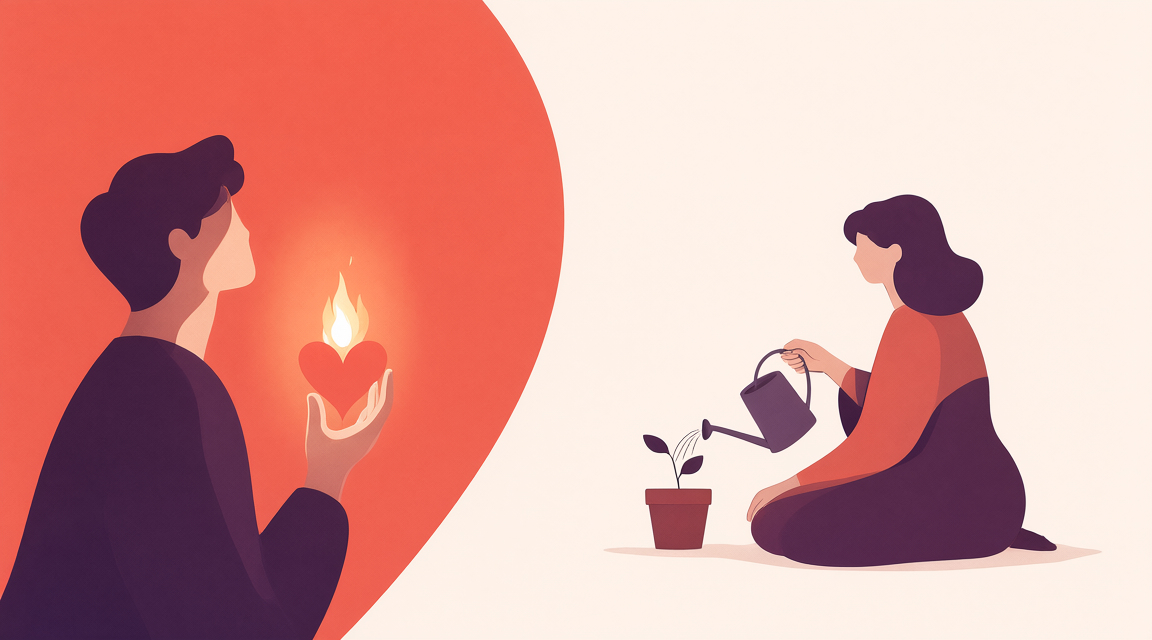
Most avoidable breakups don’t happen because of betrayal or incompatibility: they happen because two people mistook the end of infatuation for the end of love. The butterflies leave — it’s their job to leave — and someone thinks “I don’t feel it anymore, this isn’t love.” They look the other way, or cut the relationship, exactly at the moment when love, the real kind, was starting to become possible.
This guide explains what each thing is, why infatuation has an expiration date by design, and how to tell whether you’re in the crisis that breaks couples or the one that builds them. No fluff, with names attached: this is fairly standard relationship psychology (Sternberg, Fisher, Gottman’s stage work) told in plain language.
What infatuation is (and why it leaves)
Infatuation is a neurochemical state, not a soft emotion: dopamine (obsession, energy, euphoria), norepinephrine (racing heart, no sleep), and a serotonin drop (the same obsessive pattern as OCD). You are literally “crazy” about that person, and it’s functional craziness: it’s designed to pull you together and bond you.
Three facts that define it:
- It’s projection: you don’t fall for the real person, but for a version edited by your brain under the best lighting. The filters exist so the initial investment feels worth it.
- It has a deadline: 6 to 24 months typically. Not a flaw: the dopaminergic system can’t sustain euphoria indefinitely. Nobody has been infatuated (like that, capital letters) ten years running.
- It’s deliberately blind: idealization ignores signals that would alarm you in any other context. That’s why red flags get seen late.
When the cocktail wears off, you haven’t “run out of love”: you’ve finished phase one. The real person shows up. And there are two possibilities: you like the real person, or you don’t. That’s the question of this phase.
The stages that come after
Phase 2: power and negotiation (months 8-24)
Idealization drops, differences rise: money, tidiness, family, sex, time. The “I” appears against the “we.” This is where most young couples break up, because every conflict gets read as “they’re not the one.” Wrong: it’s the first time you see each other without filters. Conflict here isn’t a bad sign; not being able to talk about it is.
Phase 3: decision (2-4 years)
Chemistry no longer forces you: staying becomes a daily choice. This is the conscious commitment phase: I know this real person, flaws now visible, and I choose to build with them. Here love stops being something that happens to you and becomes something you do.
Phase 4: mature love (years)
Secure attachment, oxytocin and vasopressin instead of dopamine: calm, safety, complicity. Less euphoria, far more support. Couples who describe it as “boring” are usually comparing it to phase one — like comparing a bonfire to your home’s heating: one dazzles, the other keeps you alive.
Why people break up exactly when “I don’t feel it anymore”
The interpretation error: using the intensity of infatuation as the thermometer of love. If your only evidence of love is euphoria, the moment it drops (and it always drops, for everyone, in every relationship) your brain concludes “they weren’t my person” and the dating market whispers that someone else will make you feel “that” again. They will — and it will also end again. It’s a relationship-breaking machine.
Signs you’re in the phase 2 crisis and not in the wrong relationship:
- With this specific person, problems can be discussed.
- Your life with them is good overall, even without euphoria.
- You like them. Really: do you like their character, not just their chemistry?
- When you picture five years with them, your body says “yes,” even if your head misses the butterflies.
If instead there’s contempt, control or aggression: this isn’t the end of infatuation, it’s a damaging relationship. The exit there is different (it’s in the toxic relationship signs guide).
How to talk about this with your partner
The conversation that saves phase 2: “Lately I don’t feel like I did at the start. I want to talk about what this is for us.” Three rules: no accusations (“you don’t look at me anymore”), no catastrophizing, and one joint question: what are we building? If both of you understand that the drop in intensity is the normal calendar and not the final judgment, you cross the crisis. If only one understands, the relationship stands on one knee.
And a practical note: couples who survive phase 2 aren’t the ones sustaining euphoria — impossible — but the ones who renew novelty inside the bond: projects together, separate spaces, small surprises, talked-about sexuality. Novelty doesn’t kill love; un-talked-about routine does.
Frequently asked questions
Is real love “boring”?
It’s calm, which isn’t the same. If calm feels unbearable, it’s worth examining why: people who only recognize love as intensity often have a history of rollercoaster relationships (and sometimes, of home life).
Exactly how long does infatuation last?
Between 6 and 24 months on average, according to the research (Fisher and others). With intermittent contact (long-distance, undefined relationships) it artificially stretches: uncertainty keeps dopamine high. That’s why a two-year “situationship” feels like intense love and is nothing but phase one on a loop.
Can you feel butterflies again with the same person?
In bursts, yes: an external threat, a reunion after a trip, a new project together. But the healthy goal isn’t recovering phase one: it’s taking care of phase three. Butterflies are the trailer; love is the show.
Keep reading
If jealousy is involved in your relationship, this pairs with it: how to deal with jealousy in a relationship. And if distance is what’s cooling the bond: long-distance relationships, how they work.
Leave a Reply