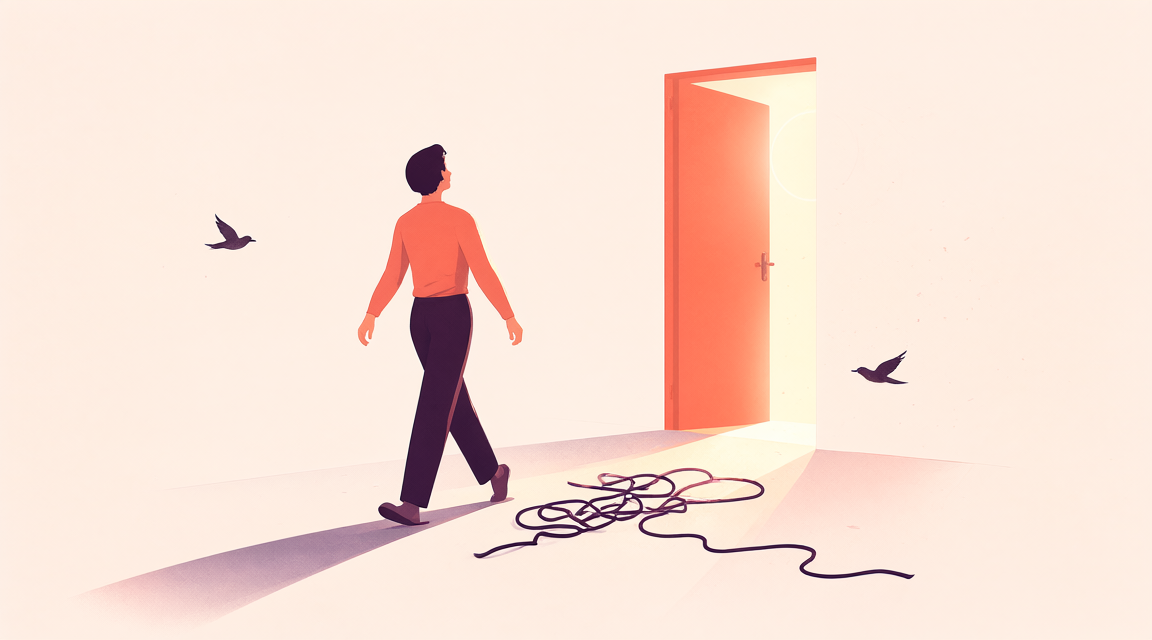
Leaving a toxic relationship isn’t an act of willpower you perform on Monday morning. It’s a process with logistics, with fear, and — most importantly — with a neurochemical trap working against you: intermittency. If your relationship has been a rollercoaster of rewards and punishments, your brain is addicted to hope the way a gambler is addicted to the slot machine. You’re not weak: you’re in withdrawal.
That changes the approach. “Just leave” doesn’t work. What works is a plan: decisions made in advance, real support around you, and logistics sorted before the emotional moment. Therapists who work with this agree: the exit is prepared cold and executed hot — never the other way around.
Why leaving is so hard (understanding it removes the shame)
- The intermittent cycle: after two weeks of coldness, one perfect night. That spike is worth ten normal relationships. It’s the most addictive reinforcement schedule that exists.
- The fixer identity: “if I try harder, I can fix this.” The other person never commits 100%, so you carry the remaining 100%. It’s an impossible task, and you take its failure personally.
- Sunk cost: years invested, a shared lease, mutual friends, “I’ve endured this much, I can’t quit now.” Past investment doesn’t obligate you to finance the future.
- Fear of the retaliation version: “they’ll fall apart without me,” “they’ll say things about me,” “they won’t make this easy.” In toxic relationships, fear is part of the control system.
The exit plan, step by step
1. Before: network and documentation (the weeks prior)
- Tell two trusted people what’s happening, with the specific list of signs (not “things aren’t great”). You need witnesses and logistics support, not an audience.
- Document: if there are threats, financial control or damage to your property, keep screenshots, messages and dates. Not for a court case (hopefully not needed): to get your reality out of your head, where gaslighting distorts it.
- Build the infrastructure: spare keys, documents (ID, passport, contracts) somewhere accessible, a bank account that’s only yours if you don’t have one, a minimum cushion of independence.
2. The conversation (short, clear, no debate)
- Choose a public place, or with someone nearby, if you sense it could get ugly. Never alone at home if there’s a history of aggression.
- Short sentence, no list of charges: “I’ve decided to end this. It’s not negotiable.” Every reason you give is a nail they can hang a counterargument on. Don’t give them nails.
- Expect escalation: the “one last perfect chance” phase arrives right here, and it’s the final proof that you’re leaving. The final good days aren’t change: they’re the system’s last attempt to recover its dopamine source.
3. After: no-contact and safety
- Strict no-contact (with the kids/work exceptions covered in the no-contact guide). Every message restarts the cycle.
- Block if needed: it’s not dramatic, it’s closing the door.
- If there are threats or violence, this is not optional: in the US call the National Domestic Violence Hotline at 1-800-799-7233 (24/7, free) or 911 in immediate danger. In the UK: National Domestic Abuse Helpline 0808 2000 247. In Spain: 016. An exit plan involving violence gets designed with professionals, not friends.
4. The relapse (plan it now)
Between half and two-thirds of exits from relationships with damaging dynamics include at least one temporary return. That’s not failure: it’s part of the process. The difference between people who leave and people who don’t isn’t willpower: it’s what you do during the relapse. A rule written and saved in your phone: “if I feel the urge to go back, I read my list of signs and wait 72 hours. If I still feel it at 72 hours, I call [trusted person] before acting.”
Signs it’s time to decide (if you’re still doubting)
- You’ve counted “the last chance” more than three times.
- Your list of “things that would change” depends entirely on their behavior, never yours.
- Your friends no longer ask “how’s everything going?” with curiosity, but with caution.
- You’ve caught yourself thinking “this is what I deserve.”
None of these get fixed with more patience. They get fixed with distance.
Frequently asked questions
What if they really change?
They can, and sometimes they do. But real change is demonstrated with months of sustained behavior (usually with their own therapy, not you as their therapist). Your job isn’t to audit their change from the inside: it’s to leave and let them prove it from the outside, without you as hostage.
Do I owe them an explanation for leaving?
Once, briefly. You don’t owe a defense of your decision: a detailed explanation in a toxic relationship is a debate where they’re both player and judge. “It hurts me and I’m leaving” is a complete sentence.
What if I’m afraid I can’t handle the loneliness?
Loneliness hurts; intermittency destroys. The first 30 days are hard and they pass. What doesn’t pass on its own is the damage of years spent adjusting to someone: that needs support (therapy, a group, trusted people), and online therapy is a very reasonable door to start through.
Keep reading
To confirm what you feel with a cold checklist: signs of a toxic relationship. And for what comes after: how to get over a breakup, step by step.
Leave a Reply